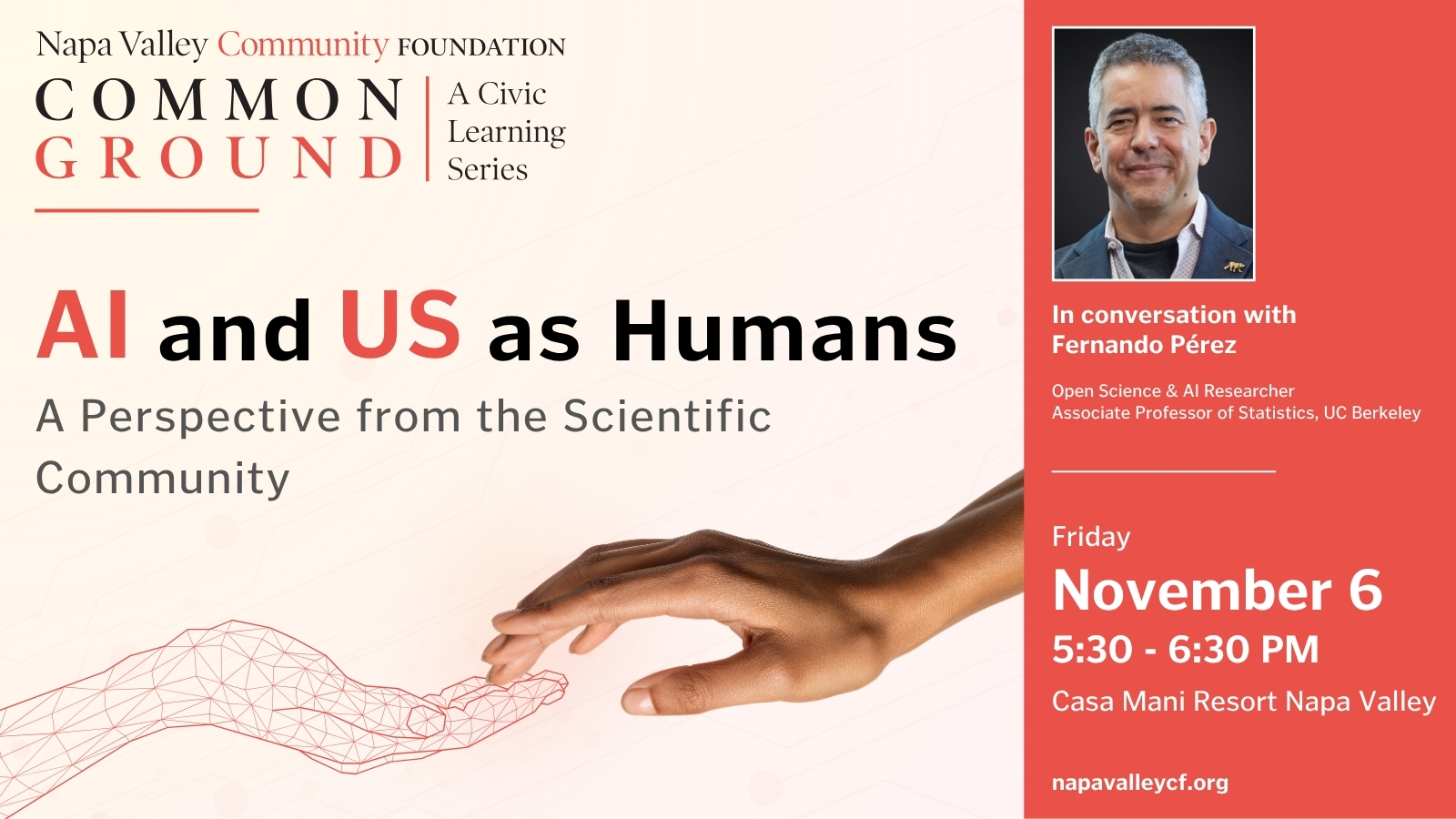
Our latest Common Ground conversation, AI and Us as Humans: A Perspective from the Scientific Community, held November 6 at Casa Mani Resort Napa Valley, drew one of the biggest crowd we’ve ever had the privilege of hosting at a Common Ground event. Thank you to every one of you who filled that ballroom. It tells us this is a conversation our community wants to have, together and in person.
Our President and CEO Terence Mulligan opened the evening with a confession: when it comes to AI, he bounces back and forth between wonderment and dread. He’s impressed with what these tools can do, and he’s concerned about how often they now come between people. As he put it, “I am less worried about the robots above us and more worried about the robots between us.”
He shared a story many of us could relate to. A longtime professional partner with whom he’s traded dozens of emails recently sent a message so smooth and polished (and so full of em dashes) that Terence knew instantly it wasn’t really his friend talking. It made him wonder if real relationships between real people are falling by the wayside of convenience.
A scientist who came for the code and stayed for the community
Our guest, Fernando Pérez, is an associate professor of statistics at UC Berkeley, a faculty scientist at Lawrence Berkeley National Laboratory, faculty director of the Berkeley Institute for Data Science, and co-director of the Eric and Wendy Schmidt Center for Data Science & Environment.
He began with his own story. Growing up in Colombia and studying physics there, he had little access to expensive journals or software. What opened the door for him were two things just emerging in the 1990s: scientists freely sharing research papers online, and open-source software anyone could use. Those tools got him into a PhD program at CU Boulder. In graduate school, he started writing open-source scientific code so he could share his work with mentors back home who couldn’t afford commercial tools.
The science and the business model are two different things
Professor Pérez shared that “AI” is a blanket term hiding two separate stories. The first is a real scientific breakthrough, which landed in our collective imagination with the public release of ChatGPT in November 2022. The second is a business model: a handful of companies racing to capture every dataset and every task under one roof, backed by some of the largest financial bets in history.
Those two are connected, he said, but not the same. The science doesn’t require that business model, and society can choose other paths.
He boiled the science down to three things that, together, are truly revolutionary:
- They work in plain language. You no longer need to be a programmer to tell a computer what to do.
- They hold a vast body of knowledge. Many sources are combined behind that natural language interface to offer a broad base of knowledge to people.
- They keep going, and keep learning. It’s an iterative process in which ideas are refined and capabilities are expanded, over time.
Imagining other futures, starting with dinner
To show how more home-grown alternatives can grow alongside big industry, Professor Pérez reached for a Bay Area favorite: Alice Waters and Chez Panisse. The restaurant’s real breakthrough, he said, wasn’t the restaurant itself. It was helping build a whole network of farmers and markets so a different way of producing food could survive. The “slow food” movement didn’t replace industrial agriculture, but it widened what was possible for all of us. Would we have salads at McDonald’s without it?
He believes open, community-built AI can play the same role. And he shared two stories, heard secondhand at a recent Berkeley gathering, about what’s already possible:
- A second chance for a family dog. A software developer with no biology background used AI to research his dog’s cancer, had the tumor’s genes sequenced, and worked with labs to produce a custom vaccine. The dog, which had been expected to die, is doing better.
- An app built for Dad. A tech worker caring for his elderly father from afar built a simple app over a weekend. It gives his dad a handful of big, easy buttons for rides, groceries, and services, while his son keeps watch behind the scenes.
“The question is not how do we stop these things,” he said, “but how do we imagine together an alternative future where these tools support society in better ways.”
He didn’t sugarcoat the harms, either. He pointed to reporting on communities facing higher utility bills and shutoffs as data centers move in, and to a wave of local ballot measures this month aimed at limiting data center growth. Those concerns are real, he said, and so is the good. Holding both is the work ahead.
Leaving a little more hopeful
“I’m feeling a little more optimistic than I was just 60 minutes ago,” Terence said as the evening wrapped up. “And the dog story is going to stay with me.”
If there was one thread running through the night, it’s that the future of AI isn’t something that simply happens to us. It’s something communities can help shape, by asking hard questions, staying connected to one another, and imagining better options together.
Missed it, or want to watch again? You can watch Professor Pérez’s talk on our YouTube channel. A quick heads-up: spotty venue Wi-Fi left the video quality inconsistent, but we think the conversation is still well worth your time.