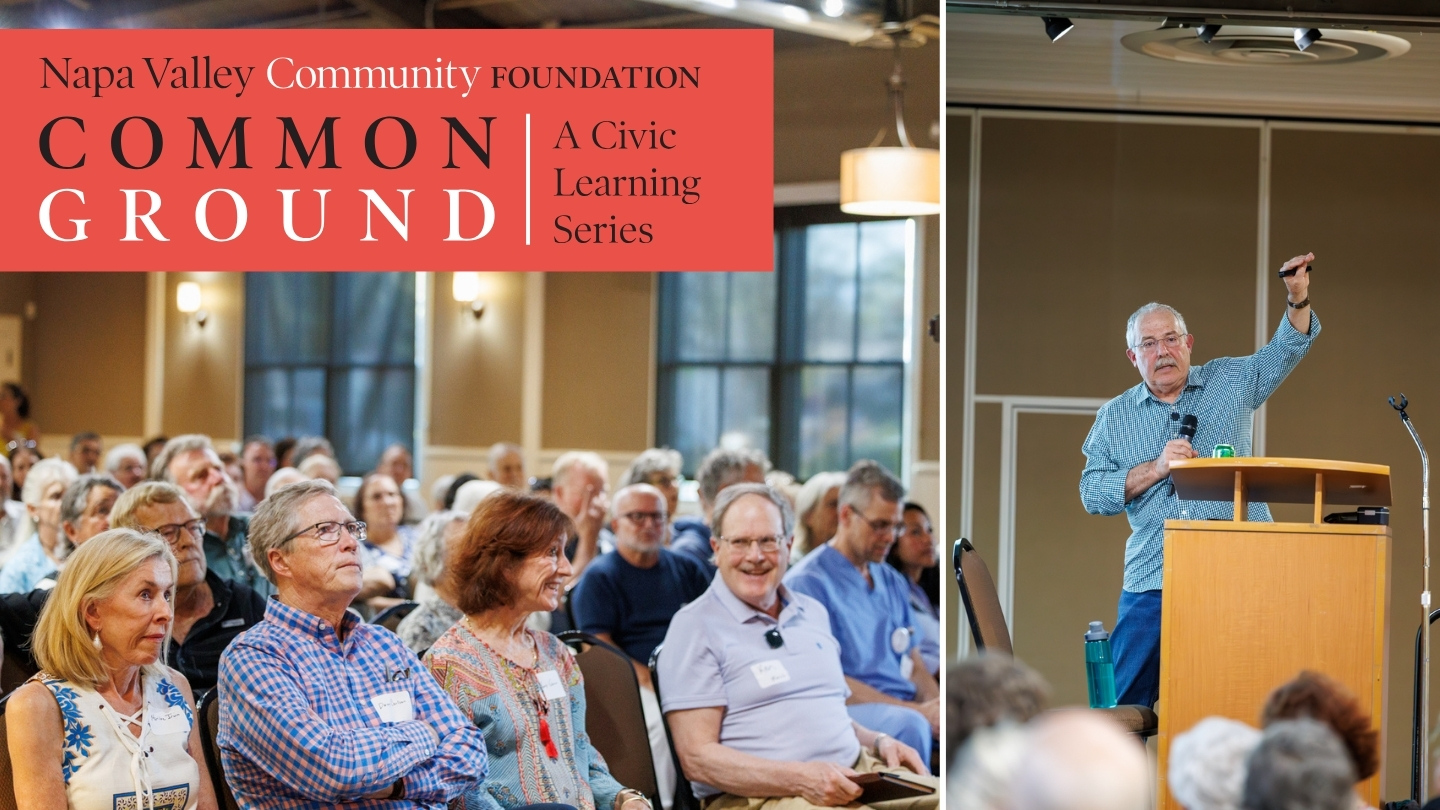
On Thursday, March 19, nearly 100 Napa Valley residents gathered at Yountville Community Center for our latest Common Ground civic learning event, focused on one thing: the science (not politics) of climate change.
Our speaker, Andrew “Drew” Isaacs – a geochemist, former NASA scientist, and UC Berkeley professor – brought both scientific expertise and real-world perspective. Over nearly three decades, he has taught current and future business leaders how climate science impacts business decision-making, having advised more than 130 companies worldwide, including Google, Toyota, and IBM. Drew’s work sits at the intersection of science, business, and practical action, and he’s uniquely skilled at making complex data accessible and relevant.
As it happens, Drew and his family are also Napa neighbors. We were grateful to have him join us as part of NVCF’s new climate education initiative, a partnership designed to bring clear, fact-based information to our community so that all of us — from policymakers to high school students — can make more informed decisions about what lies ahead.
Here’s what we heard at the event.
What the Data Is Telling Us
Isaacs shared that more than 21,000 weather stations are operating around the world, generating roughly 200,000 monthly land-surface temperature readings and nearly 15 million sea surface temperature measurements each year. Five independent gold-standard datasets — from NASA, NOAA, the UK Met Office, the EU’s Copernicus program, and Japan’s Meteorological Agency — are all tracking the same thing: sustained, accelerating warming.
The last three years (2023, 2024, and 2025) are the three warmest in recorded history. And crucially, Isaacs pointed out, that number isn’t an anomaly that will correct itself.
“Journalists will write headlines like ‘this year was the hottest,'” he said, “but that makes it sound like an event — like it got hot and then it’ll get cold again. It’s not getting cold again.”
Where Carbon Emissions Factor In
One of the most striking threads of the evening was the historical depth of climate science. In 1824, French mathematician Joseph Fourier first proposed that Earth’s atmosphere retains heat. In 1856 — four years before the Civil War — American chemist Eunice Newton Foote conducted experiments demonstrating that higher CO₂ concentrations would warm the planet. Her work was ignored, largely because she was an American woman working outside a university. Three years later, when a European man replicated her findings, the scientific world took notice.
By 1896, Nobel Prize-winning chemist Svante Arrhenius had calculated that human CO₂ emissions from burning fossil fuels were already large enough to cause global warming. That was 130 years ago.
Isaacs walked the audience through the data measuring carbon dioxide dating back to 1958; zooming out from a single week to a month to a year — where we can see CO₂ drop in summer (plants absorbing carbon) and rise in winter (plants dying and decaying) — then to the full 67-year record. The shape is unmistakable: a steep, exponential climb from about 270 parts per million to more than 430 today. Ice cores drilled in Antarctica extend that record back 800,000 years. Never, in all that time, has CO₂ risen this fast.
“CO₂ and temperature move in lockstep,” Isaacs said. “If one goes up, the other follows.”
Reasons for Hope: Electrification
Isaacs was clear-eyed about the bad news — but he saved the final portion of his talk for what he called the “green shoots” beginning to emerge. They are real, measurable, and moving faster than most people realize.
His core prescription is captured in a phrase he returns to again and again: electrify everything. The idea, Isaacs explained, is to move as quickly as possible away from burning fossil fuels and toward clean, renewable, non-carbon-emitting energy sources — for our homes, our vehicles, our businesses, and our grid. The good news is that the economics have finally caught up with the urgency. Renewables aren’t just better for the planet. They’re cheaper, increasingly reliable, and, as residents who lived through extended PSPS outages can appreciate, far more resilient.
Solar panel prices have dropped 97% in 20 years — from $10 per watt to about 30 cents per watt today. Globally, more than 92% of all new power capacity added in 2024 was renewable. In the U.S., more than 90% of new utility-scale electricity capacity planned for 2026 is solar or wind — even under the current federal administration. Clean energy investment is now running at a 10:1 advantage over fossil fuels worldwide.
Electric vehicle sales have grown roughly 30-fold since 2015. Global EV market share has grown from 3% in 2019 to 25% in 2025. In Europe and China, EVs and hybrids now account for more than half of all new car sales.
Isaacs closed with a quote from his former professor, geophysicist Henry Pollack: “The Stone Age didn’t end because we ran out of stones. It ended because we found a better way to get things done.” That moment, Isaacs said, is where we are now.
Keep Learning: Monthly Climate Seminars Coming Soon
This Common Ground event was just the beginning of our climate education efforts. Starting in May, NVCF and Drew Isaacs will host a monthly climate education seminar series — a deeper exploration of the science, the local implications, and the solutions. Whether you’re a policy maker, a business owner, a student, or simply a concerned neighbor, these sessions are designed for you.
Isaacs also recommended reading Introduction to Modern Climate Change by Andrew Dessler as the best accessible introduction to the science.
Watch the Recording


